
My experience using the victory harpia 85
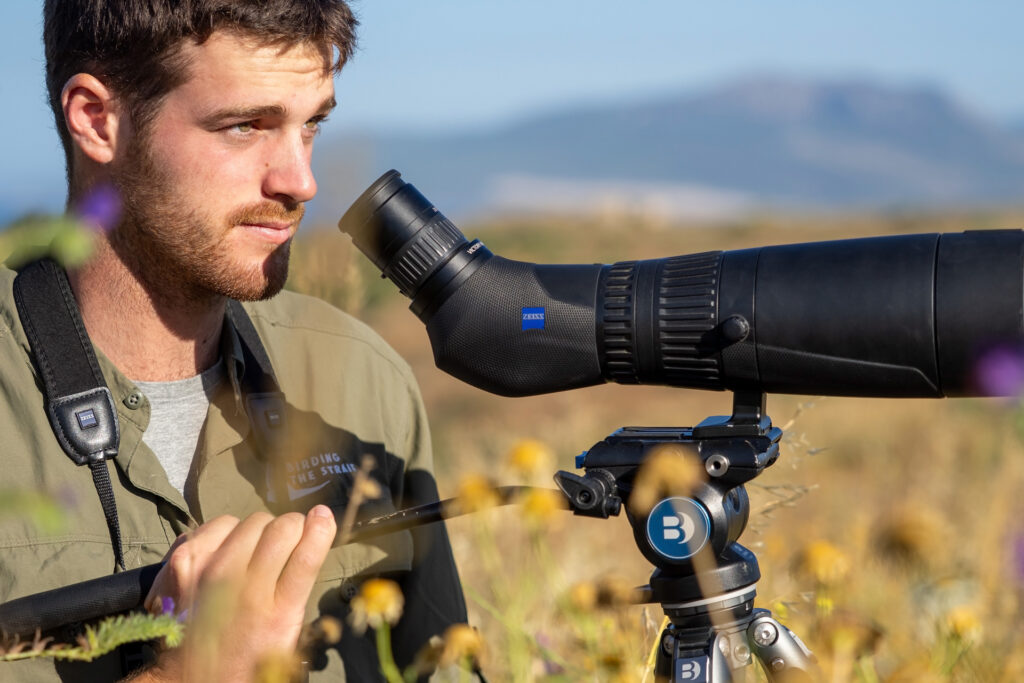
In the past year working as birding guide for Birding The Strait, I’ve used the ZEISS Victory Harpia 85 extensively, both professionally and during my free time. From the beginning, it proved to be an outstanding spotting scope, which I intend to keep using for many years to come. So, after many days and birds seen through this scope, I thought it was about time to write a full Zeiss Harpia Review, focused on real world birding use rather than technical specifications. If you are looking for a technical overview, ZEISS provides detailed specifications for the Victory Harpia on its official website.
As a flagship spotting scope, it is logical to expect notable improvements in both design and optical performance compared with the ZEISS Conquest Gavia 85, its predecessor, which I’ve used as my personal scope for three years and have always regarded as an excellent option in the brand’s mid-range lineup. You can find a complete description of the product on Zeiss’s official page.
In the present, I regularly use both models interchangeably both in professional and recreational settings. I have had numerous opportunities to evaluate them under very similar conditions, including raptor migration monitoring and seabird counts in the Strait of Gibraltar, among many other situations. So, rather than a straight comparison, the following review reflects my experience using both the Victory Harpia 85 with the Conquest Gavia, evaluating potential benefits or drawbacks of each model.
Field of View: The ZEISS Victory Harpia 85
The first characteristic that stands out when using the Harpia is its remarkably wide field of view, which creates a more open, natural, and relaxed viewing experience.
This is particularly valuable when scanning large expanses with relatively low densities of birds, such as open sea or broad stretches of sky during migration periods. In these situations, the Harpia provides an exceptional sense of control, allowing the observer to track a seabird or raptor in flight without losing sense of the surrounding context.
This wider field also increases the likelihood of detecting additional birds in peripheral vision while following a particular individual. This is specially advantageous when unexpected birds enter the edge of the field of view.
One of the clearest conclusions when I was working on this Zeiss Harpia Review is that the exceptionally wide field of view of this scope significantly enhances the birding experience in open habitats.
ZEISS HARPIA REVIEW: The Dynamic Focusing System

When it comes to focusing performance, both spotting scopes offer smooth and precise operation. However, one of the most distinctive features of the Harpia is its dynamic focusing system. This unique feature represents the main distinction of this scope from the rest in its range.
Rather than employing the traditional dual-focus arrangement with separate coarse and fine-focus controls, the Harpia uses a single focusing wheel. This magic wheel automatically adjusts its focusing speed depending on how quickly it is turned by the observer. The result is a focusing experience that feels intuitive, fluid, and highly efficient.
Personally, I have always appreciated the simplicity of a single constant-speed focusing wheel. Nevertheless, after extensive use, I must admit how practical and effective ZEISS’s solution can be. Actually, once accustomed to it, it is a feature that is noticeably missed when returning to more conventional focusing systems.
Optical Performance: Victory Harpia vs. Conquest Gavia
I have always considered the Gavia an excellent performer in terms of sharpness, brightness, and color fidelity. As this Zeiss Harpia Review demonstrates, the Harpia goes noticeably beyond in several key areas, particularly in perceived depth, contrast, and subject superposition. The image possesses a remarkably immersive, three-dimensional quality that becomes especially apparent during prolonged observation sessions.
In certain situations, this enhanced sense of depth can genuinely assist in locating birds that might otherwise blend into their surroundings. For example, when picking up the diffuse silhouette of a resting nightjar, or an Eagle-Owl perched against a rocky hillside.
Throughout my time using the Harpia, it has consistently delivered a flawlessly clean image with a remarkable absence of chromatic aberration. Only on a few occasions one could perceive minor colorations while observing under extreme conditions of lighting and distance.
Another notable strength is the consistency of illumination and image quality across the entire field of view and zoom range. By comparison, the Gavia can occasionally show slightly darker areas at highest magnifications, although its overall optical performance remains excellent.
In terms of colour fidelity, both spotting scopes provide a highly natural and neutral image. If I were to identify a difference, I would describe the Harpia’s image as being a trifle warmer. All in all, nearly identical to the Gavia in this aspect.
Portability and Build Quality: Different Approaches to Field Use

In terms of portability and construction, both spotting scopes are perfectly suitable for long days in the field and for transport in a backpack or carried on a tripod over the shoulder.
After many years of using the Conquest Gavia, I continue to appreciate its excellent balance and practical dimensions, particularly during long hikes or trips where luggage space is limited.
The Harpia remains compact for a spotting scope in its class, although it reflects a somewhat different design philosophy. It is clearly engineered with a primary focus on optimising the viewing experience and achieving the highest possible optical performance.
In practice, this difference is not so much a consequence of objective diameter—both models feature 85 mm objectives—as it is of the overall design concept and the way each scope feels during field use.
Aesthetically, both instruments display the unmistakable ZEISS design: sober styling, impeccable assembly quality, and elegant matte-black finishes.
The integration of the focusing wheel into the body contributes to a robust design. It is well protected against accidental knocks and also notably facilitates handling during transport between backpacks and luggage. The exterior armour feels durable and reassuring on both models.
Conclusion: MI HONEST OPINION ON THE ZEISS HARPIA

After extensive use of both models, I consider the ZEISS Conquest Gavia and the ZEISS Victory Harpia 85 to be outstanding spotting scopes within their respective categories.
The Harpia stands out by delivering an exceptionally immersive viewing experience. It offers a truly impressive field of view and an outstanding performance. These features place it among the top-range spotting scopes available for birding and wildlife observation.
Is the Victory Harpia worth its premium price? For birders who spend many hours behind a spotting scope and value the widest possible field of view, exceptional optical quality, and an immersive viewing experience, my answer would be yes.
The Gavia, meanwhile, remains an extraordinarily well-balanced option for those seeking a more versatile and cost-effective spotting scope without compromising on optical quality.
In summary, this Zeiss Harpia Review reflects my experience after extensive field use across a wide variety of birding situations. If you are interested in testing these optics in the field yourself, don’t hesitate to book one of our birding daytrips to see the wonders of the Strait of Gibraltar through ZEISS optics!